History & Legends
From Border Fortress to Royal Home
On 1 December 1920, the people of Brașov gave their queen a castle. The city council voted unanimously to hand Bran to Queen Marie of Romania as a thank-you present. By then the old fortress had spent more than 500 years guarding a mountain road and taxing the traders who used it.
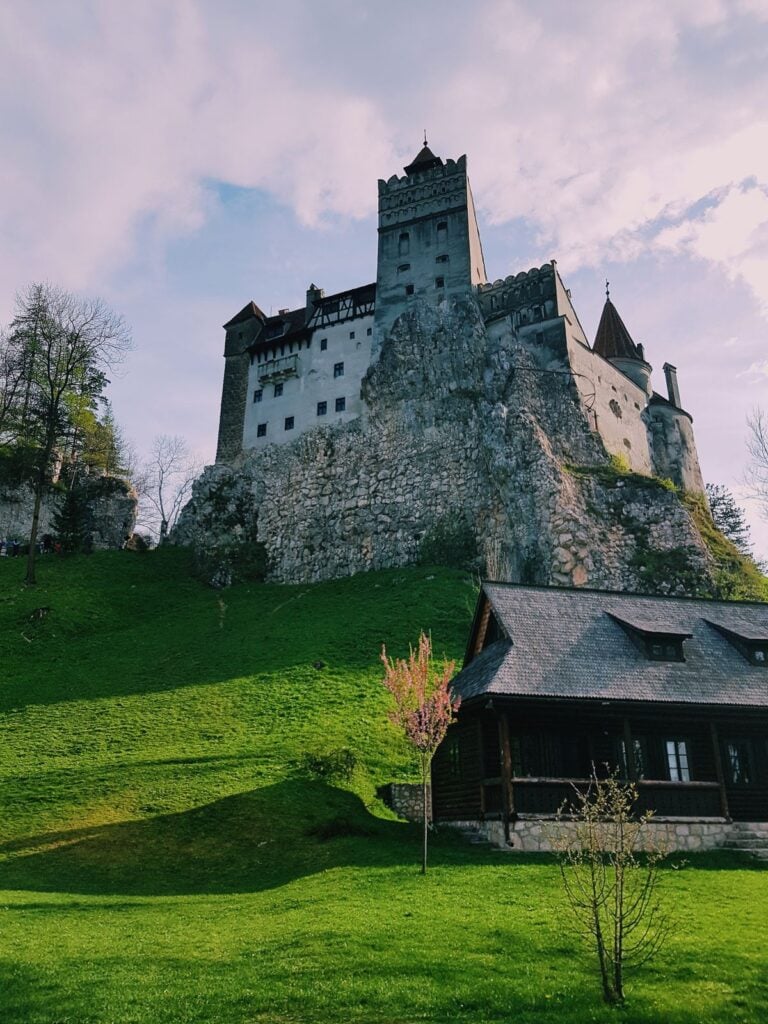
A stone gate on a mountain road
The name Bran comes from a Slavic word for “gate,” which suits the place. The castle sits at the mouth of a pass through the Carpathian Mountains, on the road between Transylvania and Wallachia, the principality to the south.
Old records say the Teutonic Knights, a German crusading order, built a wooden fort here called Dietrichstein around 1212. The king of Hungary threw the knights out of the region about 13 years later. Some historians doubt the knights ever built anything on this spot.
The stone castle came later. On 19 November 1377, King Louis I of Hungary gave the Saxons of Brașov permission to build a fortress here, as long as they paid for it and did the work themselves. The Saxons were German-speaking settlers whom Hungarian kings had invited to Transylvania two centuries earlier.
That royal charter is the first document to name Bran. It calls the castle a new fortress on “Dietrich’s rock,” a nod to the old wooden fort, and the work was finished by 1388. The builders shaped it to fit the uneven rock, so its rooms sit on different levels, linked by narrow stairs and twisting passages.
Collecting tolls at the border
For centuries Bran worked as a customs house. Officials here kept 3 percent of the value of goods passing in and out of Transylvania, and a small garrison watched the road for raiders from the south.
The garrison saw action. In 1441 or 1442 John Hunyadi, the Hungarian general who later governed the kingdom as regent, defeated an Ottoman force right at the castle walls.
The castle changed hands several times. Mircea the Elder, prince of Wallachia, held it for a few years in the early 1400s. In 1498 the city of Brașov paid 1,000 florins for ten years’ use of Bran, and in 1651 the city bought it outright from George Rákóczi II, prince of Transylvania.
Bran’s working life ended in 1836, when the border moved up to the crest of the mountains and the castle lost its job. In 1888 Brașov handed it over to the regional forestry office, and for the next few decades it saw more foresters than soldiers.
A thank-you gift for a queen
Marie was born in England in 1875, a granddaughter of both Queen Victoria and Russia’s Tsar Alexander II. At 17 she married Ferdinand, heir to the Romanian throne, and she became queen in 1914.
During the First World War she nursed wounded soldiers, and Romanians called her the “Mother of the Wounded.” In 1919 she went to the peace conference in Paris to argue Romania’s case.
Brașov gave her Bran to thank her for that work. Karl Schnell, the city’s mayor, led the council vote.
Turning a fortress into a summer home
From 1920 to 1932 Marie turned the old fortress into a royal summer residence. She worked with the Czech architect Karel Liman, who had also worked on the royal castles at Sinaia.
The castle got running water and electricity for the first time. Workers installed a lift between the castle and the park below to spare the queen, who suffered from arthritis, the steep climb. In 1932 a small hydroelectric plant on the Turcu stream began supplying power to the castle and the villages around it.
Marie added a spiral staircase between the upper floors. A narrow secret passage hidden in the walls links the first floor with the third.
The well in the courtyard drops 57 meters. It never supplied enough water, so the castle’s water comes from mountain springs.
A queen’s heart and a princess’s hospital
Marie died on 18 July 1938 and left Bran to her youngest daughter, Princess Ileana.
The queen had asked for her heart to be buried at Balchik, her seaside retreat on the Black Sea. In 1940 Romania handed that stretch of coast back to Bulgaria, so the heart came to Bran. It traveled in a silver casket set inside a jeweled one, wrapped in the flags of Romania and Britain, her two homelands.
Its new resting place was a marble sarcophagus inside a chapel carved into the rock across the valley. The heart moved twice more. In 1968 communist officials vandalized the chapel, and in 1971 they moved the heart to the National History Museum in Bucharest. Since 2015 it has rested at Pelișor Castle in Sinaia, in the room where Marie died.
Ileana had a busy war of her own. In 1944 she built a hospital in Bran for wounded soldiers and named it “The Queen’s Heart.” She worked there as a nurse until January 1948.
From state museum back to the family
That month the new communist government forced Romania’s royal family into exile and took the castle. In 1956 the state opened Bran as a museum, and a long restoration followed from 1987 to 1993.
Ileana settled in the United States, where she became an Orthodox nun called Mother Alexandra in 1961. She later founded a monastery in Ellwood City, Pennsylvania. When she died in 1991, she was buried with a small box of soil from the foot of Bran Castle.
After the fall of communism, Romania passed a law in 2005 to return property the old regime had seized. On 18 May 2006 the government handed Bran back to Ileana’s children, led by her son Archduke Dominic. The state kept running the museum for three more years.
In 2009 Ileana’s heirs reopened the castle as Romania’s first private museum, and they run it to this day.