History & Legends
Count Dracula
Jonathan Harker is shaving at the window of a Transylvanian castle when a hand settles on his shoulder and a voice wishes him good morning. He jumps and nicks his chin. In his little shaving mirror he can see the whole room behind him, and his host is nowhere in it.
Then the Count spots the blood. His eyes blaze and he lunges for Harker’s throat, until his hand brushes the crucifix on a string of beads around the young man’s neck. The fury drains away. The Count snatches up the mirror and flings it out the window, where it smashes on the stones of the courtyard far below.
That scene comes from the second chapter of Dracula, the novel Bram Stoker published in London in May 1897. Stoker’s Count went on to become the most famous vampire in the world.
The theater manager who invented a monster
Abraham “Bram” Stoker was born in Dublin in 1847. By day he ran the Lyceum Theatre in London for Henry Irving, the biggest stage star in Britain. He wrote fiction in his spare time.
Dracula took him about seven years. His working notes, now kept at the Rosenbach Museum in Philadelphia, show that he first called his villain Count Wampyr.
Stoker built his Transylvania in libraries, from travel guides and maps. He also read Emily Gerard, a Scottish writer who had lived in Transylvania in the 1880s and wrote about local beliefs in ghosts and the walking dead. No record shows that Stoker ever set foot in Romania.
A story told in letters and diaries
Stoker told the whole tale through documents. Readers piece it together from diaries, letters, newspaper clippings and a ship’s log, as if someone had gathered the evidence into one thick file.
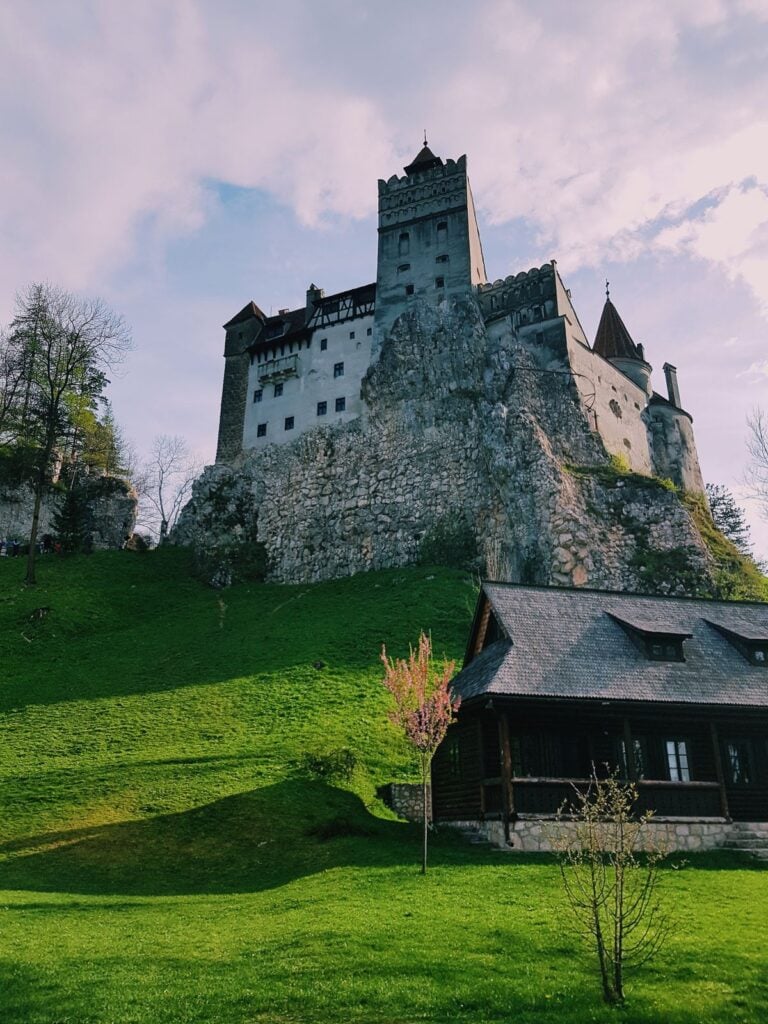
Harker, a young English lawyer, travels to Castle Dracula near the Borgo Pass, in the far north of Transylvania, to help the Count buy a house in London. He soon works out that he is a prisoner. The Count sails for England hidden among fifty boxes of Transylvanian earth.
His ship runs aground at Whitby, on the Yorkshire coast, with its dead captain lashed to the wheel. A huge dog leaps ashore and disappears into the town.
In England the Count feeds on Lucy Westenra, a bubbly young woman, and turns her into a vampire. Then he goes after Mina, the clever schoolteacher Harker marries partway through the book. Professor Abraham Van Helsing, a Dutch doctor who knows the old lore, leads a small band of men against him.
The hunters chase the Count all the way back to his castle. Just before sunset, Harker slashes his throat with a big curved knife while Quincey Morris, a Texan, drives a Bowie knife into his heart. The Count crumbles into dust. Morris dies of his wounds a few minutes later.
Meet the Count, as Stoker wrote him
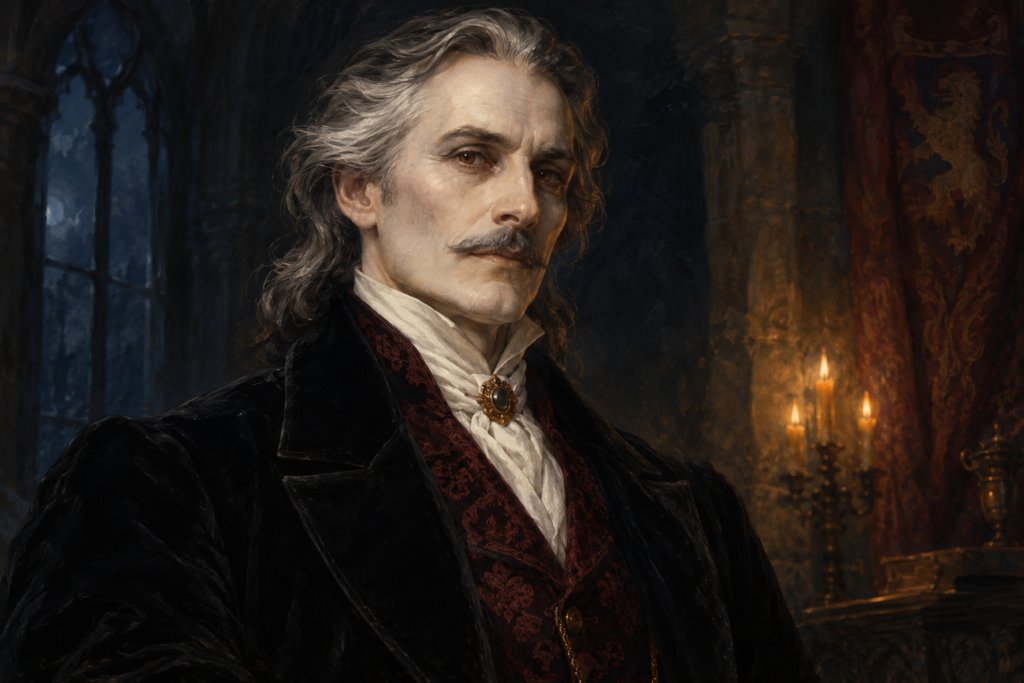
The Count of the novel is a tall old man with a long white mustache, dressed in black from head to foot. Harker notices pointed ears and sharp white teeth that poke out over his lips. Hair grows in the middle of his palms, and his breath is foul.
He gets younger as he feeds. When Harker spots him on a London street, the white mustache has turned dark.
He boasts that he is a Székely, one of the Hungarian-speaking people of eastern Transylvania, with the blood of Attila the Hun in his veins. When it suits him, he becomes a wolf or a bat. Mist works too, for slipping under doors. One night Harker watches him crawl headfirst down the castle wall, “lizard fashion,” with his cloak spread out like wings.
He has his limits. Mirrors show no trace of him. He must rest in the soil of his homeland, which is why he hauls all those boxes to England. A house stays closed to him until someone inside invites him in, and garlic and the crucifix drive him back.
Sunlight weakens him in the book, and he still strolls around London by day. The idea that the sun kills vampires came later, from the movies.
Where vampires came from
Vampires were old news by 1897. Romanian villagers told stories of the strigoi, restless dead who climbed out of their graves to plague the living. In the 1720s and 1730s, Austrian officials in Serbia sent home reports of villagers digging up corpses they blamed for a run of deaths. Newspapers across Europe picked up the stories, and around then the word “vampire” started turning up in English.
Writers grabbed the idea. In 1816 Lord Byron challenged friends staying with him beside Lake Geneva to write ghost stories. Mary Shelley began Frankenstein that summer, and Byron’s doctor, John Polidori, wrote “The Vampyre,” published in 1819, about a charming aristocrat with a taste for blood.
In 1872 the Irish writer Sheridan Le Fanu published “Carmilla,” about a female vampire who preys on a lonely young woman in a castle. Stoker, another Dubliner, borrowed from it.
From the stage to the silver screen
Stoker died in 1912, years before film made his Count a star. In 1922 the German director F. W. Murnau made Nosferatu without permission and renamed the Count “Orlok.” Stoker’s widow, Florence, sued, and the film’s makers were supposed to destroy every copy. A few survived, and Nosferatu gave the world its first vampire killed by sunlight.
The Count’s evening clothes and cape came from the theater. In 1924 the actor-manager Hamilton Deane turned the novel into a stage play, and a rewritten version opened on Broadway in 1927 starring the Hungarian actor Bela Lugosi. Lugosi took the role again in Universal’s 1931 film, directed by Tod Browning, and his slow, heavily accented “I am… Dracula” set the Count’s look and voice for generations.
Plenty more followed. Christopher Lee bared his fangs in a run of British Hammer horror films starting in 1958, and since 1972 a purple vampire named Count von Count has taught children to count on Sesame Street.
Stoker’s novel has never gone out of print. The story of his villain’s name, and the real prince who may stand behind it, comes next in “The Prince Behind the Name.”